All services
139 services across 13 categories. Open any one to see what it involves. If what you need is not listed, call and ask.
Find a service
Search by what you need rather than by category. Try “leak”, “tile”, “gutter” or “certification”.
Commercial Roofing
Re-Roofing
A single-ply thermoplastic membrane, hot-air welded at the seams. Reflective, and the usual starting point for a new low-slope roof.
Single-ply like TPO but chemically resistant, which is what separates the two. The right answer where grease or chemical exhaust lands on the roof.
Single-ply rubber supplied in wide sheets, so a large simple roof ends up with far fewer seams. Long service life and straightforward to patch.
Alternating layers of asphalt and reinforcing felt built up in plies. Heavy and redundant by design, which is why it is still specified.
Asphalt cap sheets, torch-applied or self-adhered, over a prepared substrate. Often the repair-friendly answer on an existing asphalt roof.
Metal panels joined by raised seams with the fasteners concealed underneath, so nothing penetrates the weather surface.
Metal panels that span between purlins and carry load themselves, rather than sitting on a continuous deck.
A fluid-applied silicone membrane over a sound but ageing roof. Adds service life without a tear-off, and holds up under ponded water.
A water-based reflective coating. Lower cost than silicone and repairs easily, but it wants a roof that drains rather than ponds.
A tougher coating than acrylic or silicone, used where the roof takes foot traffic, hail or mechanical abuse.
Foam sprayed in place as insulation and waterproofing in one pass. It self-flashes around penetrations, so there are no seams to fail.
A new membrane installed over the existing roof instead of tearing it off. Cheaper and faster, and code generally allows one recover.
A vegetated assembly over a waterproofed deck. Adds insulation and slows stormwater runoff, and needs waterproofing detailed for it from the start.
New Construction
Full assembly from the deck up: insulation, cover board, membrane, flashings and edge metal as one system.
Rigid board between the deck and the membrane. Sets the roof's R-value, and on most buildings is the largest single energy item on the envelope.
A layer below the insulation that stops warm interior moisture reaching the cold underside of the roof and condensing inside the assembly.
Insulation cut to a slope so water runs to the drains instead of standing. The design work is laying out crickets and valleys to actually get it there.
Primary drains and overflows, sized and placed so the roof clears water in a design storm rather than holding it.
A detailed break in the roof where the building itself moves. Without one the membrane takes the movement and eventually splits.
Bonded traffic pads routing foot traffic to rooftop equipment. Membrane damage on a serviced roof is usually a path worn by technicians.
Anchors and lifelines for anyone working near a roof edge, installed and flashed so the attachment does not become a leak.
Roof Repair Services
An active leak stopped now rather than scheduled. Water in a building damages the interior faster than it damages the roof.
A known leak booked for a planned visit, once the water has been stopped and the roof is dry enough to work on properly.
Repairs after wind, hail or debris, documented so the scope matches what the storm actually did.
Re-securing membrane or metal that has lifted at an edge or corner. Uplift starts at the perimeter, which is where the pressures are highest.
Replacing the metal or membrane where the roof meets a wall, curb or penetration. Most roofs leak at a flashing rather than in the open field.
The capping along the top of a parapet wall. When its joints open, water runs down inside the wall rather than off the roof.
Clamping rings, strainers, bowls and the membrane termination at the drain, which is the lowest point on the roof and the most punishing detail.
The outlet through a parapet that drains a roof over the edge. A failed scupper backs water up onto the roof it is meant to relieve.
Curbs, flashings, gaskets and glazing. A skylight is a hole in the roof, and everything that keeps it dry is at its edges.
Boots, collars and sealant where pipes and conduits come through. These fail on a shorter cycle than the roof around them.
The raised, flashed frames under rooftop units. Curb flashing is the most common leak source on a mechanically loaded commercial roof.
Access hatches, their curbs and their flashings, including the seal that keeps the hatch itself watertight when closed.
Flashings and trim formed to match a condition on the building rather than adapting the building to stock parts.
A localised repair to the membrane where it has been punctured, split or worn, tied properly into the surrounding roof.
Preventative Maintenance
One documented inspection a year, which is the minimum cadence at which a small fault gets found before it becomes a wet roof.
Twice a year, typically before and after the wet season, so the roof enters winter sound and is checked once it is over.
Four visits a year, for roofs with heavy equipment, heavy traffic or a tenant who cannot take an interior leak.
Removing dirt, biological growth and debris from the surface. Some of it holds moisture against the membrane; some of it simply hides damage.
Clearing drains, strainers and leaders. A blocked drain turns a rainstorm into standing load the roof was not designed to hold.
Clearing gutters and downspouts so water leaves the roof edge instead of overflowing behind the fascia.
Clearing branches, litter and construction leftovers. Debris abrades the membrane underfoot and finds its way to the drains.
Renewing the sealant at terminations, counter flashings and penetrations. It is the shortest-lived material on the roof and is meant to be replaced.
Checking every flashed condition specifically, because that is where a roof fails long before its field membrane does.
Photographs of what was found and what was done, so the roof's condition is a record rather than a recollection.
An estimate of what the roof will need and roughly when, so the spend is planned rather than an emergency.
Tracking condition, age, warranty and history across a portfolio of roofs, so money goes to the roof that needs it next.
The inspections a manufacturer's warranty requires. Skipping them is one of the common ways a valid warranty quietly stops being valid.
A written record of each visit: what was inspected, what was repaired, and what is being watched.
Condition and remaining-life figures in the form a reserve study or a capital budget actually needs.
Roof Restoration
A fluid-applied silicone membrane. It tolerates standing water better than the alternatives, which matters on a roof that does not fully drain.
A reflective water-based coating for roofs that drain well. Lower cost than silicone, and easy to recoat later.
A tougher coating than acrylic or silicone, used where the roof takes foot traffic, hail or mechanical abuse.
A reflective aluminium-pigmented coating, generally over asphalt systems, to cut heat and slow the ultraviolet ageing underneath.
Treating an ageing asphalt or single-ply surface to restore flexibility, rather than covering it with a new membrane.
Reinforcing fabric and coating over seams and details before a restoration coat, because the seams are where a restored roof fails first.
Membrane assemblies for surfaces that hold water or take traffic, detailed differently from a roof that only sheds rain.
Washing and preparing the surface so the coating bonds. Most coating failures are adhesion failures, and adhesion is decided here.
A thermal survey that finds wet insulation under an intact membrane, so a restoration is not sealed over a roof that is already saturated.
Building Envelope Services
Keeping water out of surfaces that are not roofs: decks, planters, below-grade walls and anything that holds water rather than shedding it.
A walkable waterproof coating over a walking deck, so the surface people stand on is also the surface keeping the space below dry.
Membrane, flashing and drainage on an elevated balcony, including the wall junction, which is where balcony leaks almost always start.
Waterproofing under pavers, planters or vehicle traffic, where the membrane is buried and a later repair means removing everything above it.
Replacing the joint covers and seals that let a building move. A failed joint leaks along its whole length rather than at one point.
Sealing joints in the wall and roof envelope. Consumable by design, and one of the cheapest things that stops being maintained.
Sealing the joints between panels, precast or dissimilar materials, where movement and water both concentrate.
Through-wall and counter flashing that collects water inside the wall and directs it back out, instead of down into the structure.
Flashings, trim and transitions formed to fit the actual condition on the building.
Coatings and membranes on the wall itself, for buildings where the water is coming through the facade rather than the roof.
Sheet Metal Division
Capping along the top of a parapet. It has to shed water outward and absorb the wall's movement at every joint.
The metal along the roof edge, holding the membrane's edge down and finishing the line of the building.
The edge metal that terminates a built-up roof and keeps the surfacing on the roof rather than in the parking lot.
Collecting water at the eave and carrying it to a downspout, sized for the roof area and the local rainfall rather than by habit.
Taking water from the gutter to the ground or the storm system, and discharging it far enough out to keep it away from the foundation.
The box where a scupper or gutter feeds a downspout, catching a large flow and turning it down a smaller pipe.
Flashings formed for conditions that have no stock part: an odd angle, an old profile, a penetration nothing was made for.
The upper piece lapping over base flashing at a wall, so water running down the wall is shed clear rather than behind it.
Capping and flashing at a chimney. Its four sides each drain differently, which is why chimneys leak more than their size suggests.
Screening that hides rooftop units from the street, framed and flashed so the screen's own supports do not become penetrations.
Architectural metalwork on the roofline where the metal is part of how the building looks, not only how it drains.
The tested edge assembly holding the membrane down at the perimeter. Wind takes a roof at its edge, so this is the detail that governs.
Roof Inspections
Documenting condition and damage in the form an insurer needs, separating storm damage from age and wear.
A roof condition report for a sale, covering what is there, what condition it is in, and what the buyer is taking on.
A written statement of the roof's condition and remaining life, commonly required by escrow before a sale closes.
Aerial imagery of a roof that is steep, fragile or hard to reach, which also gives a complete overhead record rather than spot checks.
Thermal imaging that shows where insulation is wet under an intact membrane, so a repair is scoped to the wet area rather than the whole roof.
The inspections a manufacturer's warranty requires. Skipping them is one of the common ways a valid warranty quietly stops being valid.
The scheduled look that catches a failing detail while it is still a repair rather than a replacement.
A roof assessment during a purchase or refinance, when the question is what the roof will cost over the hold period.
Roof condition and remaining life in the form a homeowners association or asset manager needs to fund a future replacement.
Solar Support
A check before a known event: a storm season, a solar install, or a tenant moving in underneath.
Taking an array off so the roof beneath can be repaired or replaced, then putting it back. Re-roofing under a live array is not possible.
Repairing the flashings at array attachments, which are roof penetrations and fail like any other penetration.
Waterproofing every mount where it passes through the roof, on the assumption that each one is a hole until it is properly flashed.
Sequencing roof work with a solar installer so neither trade voids the other's work or warranty.
Emergency Services
Response outside business hours, because a roof leak does not wait for one and interior damage accumulates hourly.
Covering the opening now to stop water entering, ahead of any permanent repair.
A short-term watertight layer that holds while a permanent scope is priced, approved and scheduled.
Assessment and stabilisation after a storm, prioritised by where water is actually getting in.
Securing loose edge metal, equipment and debris before a wind event, since most of what damages a roof in a storm was already loose.
Checking edges, corners and fasteners after high wind, where uplift damage begins and is easy to miss from the ground.
Getting a damaged building back to watertight and documented, in an order that lets the interior repairs start.
Residential Roofing
Architectural and three-tab shingle. The most common roof in the region, the quickest to install and the easiest to match on a partial repair.
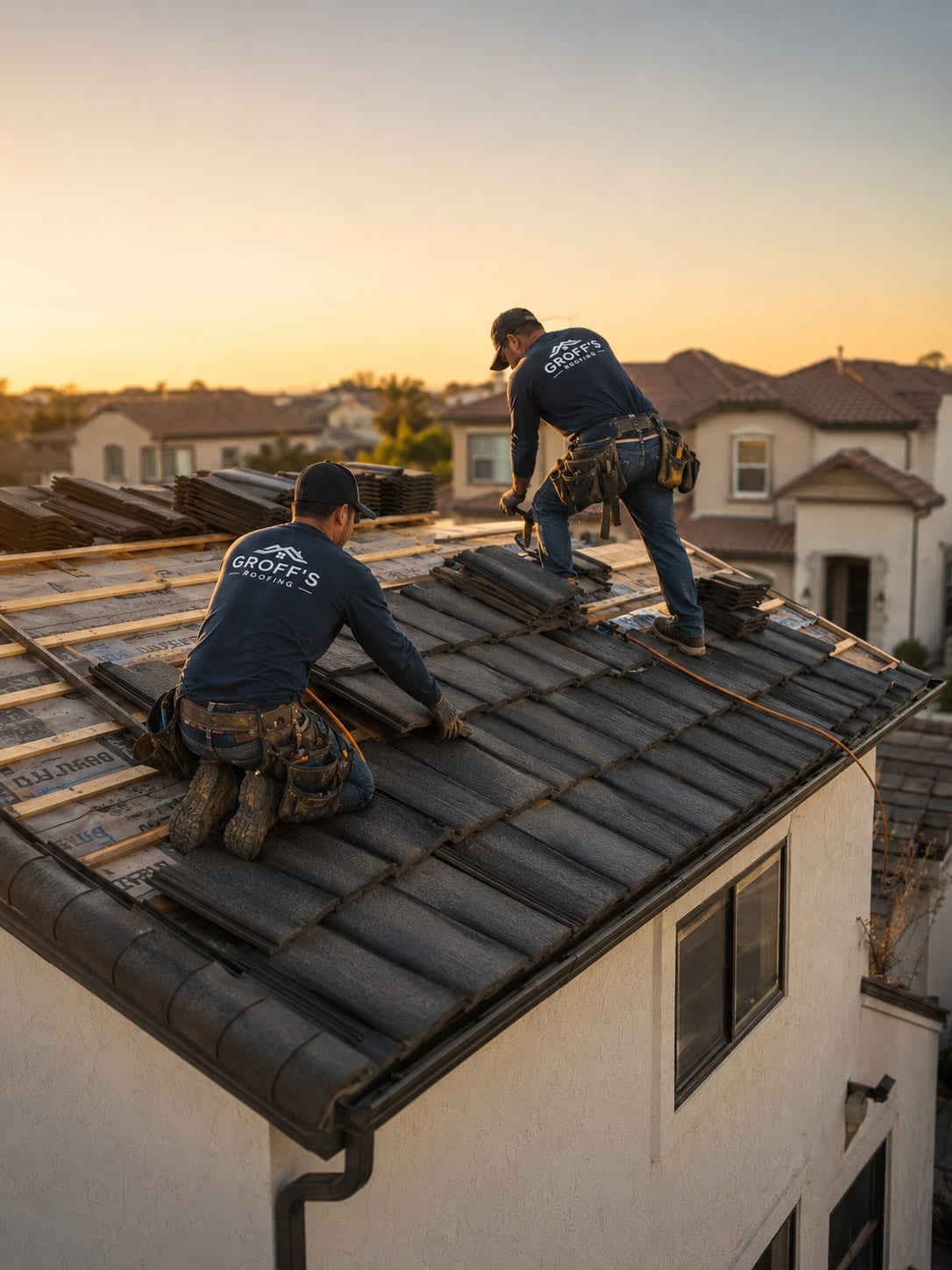
Concrete and clay tile roofs, repaired in place or lifted and re-laid. The tile normally outlasts the underlayment beneath it.
Heavy, long-lived, and already on most Chino Hills streets. Individual tiles can be swapped without disturbing the surrounding field.
Traditional barrel and S-tile. Repairs depend on matching an existing profile, which is often the harder half of the job.
Concealed-fastener metal panels with nothing penetrating the weather surface, which is where an exposed-fastener panel eventually leaks.
The look of tile or shake at a fraction of the weight, for a structure never framed to carry tile.
Composite slate profiles without the weight of quarried slate or the structural upgrade it would need.
Low-slope sections on a house: a patio cover, an addition, a deck over living space. These use commercial materials, not shingles.
A single-ply commercial membrane on a residential low-slope section, where a shingle roof would not be watertight at that pitch.
A coating over a sound residential low-slope roof to add service life without a tear-off.
Localised residential repair: slipped tile, failed flashing, a penetration, a wind-damaged section.
Stripping to the deck so the sheathing can be inspected and any rot replaced before the new roof goes on.
A written statement of the roof's condition and remaining life, commonly required by escrow before a sale closes.
Scheduled residential inspection and upkeep, in place of waiting for a stain on a ceiling.
Rainwater Systems
Gutter formed in one continuous length on site, so there are no joints along the run to open up later.
Covers that keep leaves out of the gutter. They reduce cleaning rather than remove it.
Taking water from the gutter to the ground or the storm system, and discharging it far enough out to keep it away from the foundation.
Changing where water goes once it leaves the roof, usually because it is currently arriving somewhere it should not.
The vertical pipe carrying roof water down, whether run on the face of the building or inside it.
An outlet through a parapet that lets a flat roof drain over the edge, often as the overflow for a drained roof.
Specialty Services
Aerial imagery assembled into a measured, marked-up map of the roof and its conditions.
A drawn plan of the roof with penetrations, drains and details located, so scopes and bids describe the same roof.
Measured quantities from drawings or a survey, so a bid is priced off real areas rather than an estimate.
Locating trapped water in the assembly by infrared, capacitance or nuclear survey, depending on the roof.
Cutting a small test opening to see what the roof is actually built of, which drawings and assumptions frequently get wrong.
Measuring the attachment's resistance to uplift, on a roof whose fastening pattern or history is unknown.
A full survey with findings, remaining life and a prioritised list of what to do and in what order.
Reviewing roof access, fall hazards and tie-off provision against what a person working up there actually needs.
Where people get onto the roof, how they move across it, and how that traffic is kept off the parts that damage easily.
Service Department
A single call about a single leak, without a maintenance agreement in place.
Roof work driven by a fit-out below: new penetrations, relocated units, a patched deck where something was removed.
Ongoing scheduled upkeep, priced as a programme rather than as separate visits.
Repairs carried out under an existing manufacturer or contractor warranty, and documented so the warranty stays intact.
Unscheduled response when the roof has failed and cannot wait for the next available slot.
Work too small to be a project and too large for a service call: a section of flashing, one curb, a run of edge metal.
One documented inspection a year, which is the minimum cadence at which a small fault gets found before it becomes a wet roof.
A standing arrangement covering scheduled visits and priority response, so a leak is a phone call rather than a procurement exercise.

Where we work
Based in Chino Hills. We cover the Inland Empire, the San Gabriel Valley and north Orange County, plus the wider Southern California region.
Not sure which service you need
Describe the problem instead of picking a category. Most roofing faults are diagnosed from a description and a photograph.
Active leak or storm damage today? Call instead. Emergency response does not go through a form.
info@groffsroofing.com